Domestic Political Conditions and the Acceleration of Japan-Philippines Security Cooperation
/By Mari Kawai, edited by Chiara Infante
1. Introduction
In recent years, security cooperation between Japan and the Philippines has accelerated at an unprecedented pace. This development is commonly explained by China’s increasing assertiveness in the South and the East China Sea, and across the Taiwan Strait. In addition, there is uncertainty about the US's future involvement in this region. These external pressures have undoubtedly played a central role in building stronger ties between the two states. However, they do not fully explain why bilateral security cooperation has been rapidly facilitated. As a senior official from Japan’s Ministry of Foreign Affairs remarked, Japan wanted to conclude its agreement with the Philippines “While the weather is nice” because it is uncertain whether the next Philippine administration would maintain the same foreign policy direction [1]. This statement suggests that Japanese policymakers regarded the current domestic political environment in the Philippines as a limited window of opportunity.
This article, therefore, focuses on domestic politics in both Japan and the Philippines. Importantly, it does not disagree that the current regional environment is the reason for accelerated Japan-Philippine cooperation. Also, China’s growing assertiveness undoubtedly influenced public opinion and the strategic preferences of both governments. However, it did not automatically produce the rapid cooperation observed under the current administrations. Hence, this article argues that the domestic political conditions under the Marcos administration in the Philippines and the Takaichi administration in Japan create a unique opportunity to institutionalise and deepen bilateral security cooperation.
The article first outlines the recent expansion of Japan-Philippines security cooperation before examining how changes in political leadership and the domestic political conditions in the Philippines and Japan contributed to its rapid development.
2. The Rapid Expansion of Japan-Philippines Security Cooperation
Japan-Philippines relations have traditionally been characterised by close economic cooperation. In recent years, however, bilateral relations have expanded beyond economic ties and entered a new phase centred on security and defence cooperation.
A major milestone was the signing of the Reciprocal Access Agreement (RAA) in 2024, which entered into force in September 2025. It is a legal framework for military cooperation, facilitating joint exercises and other defence activities while improving interoperability between the two countries [2]. In Japan, the agreement has frequently been described as a “quasi-alliance” [3], reflecting the promotion of bilateral relations as one of Japan’s closest security partners after the US, which is Japan’s only alliance state. Building upon the RAA, Japan and the Philippines signed the Acquisition and Cross-Servicing Agreement (ACSA) in January 2026. The agreement provides a framework for reciprocal logistical support between the Japan Self-Defence Forces (JSDF) and the Armed Forces of the Philippines (AFP), enabling smoother defence cooperation and reinforcing their joint contribution to regional and international security [4].
Defence cooperation has also expanded through Japan’s Official Security Assistance (OSA) programme, launched in 2023. It is a grant-based framework through which Japan provides defence equipment, supplies, and infrastructure support to the armed forces and other relevant institutions of partner countries. This initiative is intended to enhance their security and deterrence capabilities, deepen Japan’s security cooperation with like-minded partners, and contribute to a stable regional and international security environment [5]. Among all recipient countries, the Philippines has become one of Japan’s most important OSA partners [6]. In the 2026 package, which is the third OSA to the Philippines, Japan assisted with 900 million yen (JYP) to construct boathouses and slipways for the Philippine Navy’s Rigid-Hulled Inflatable Boats (RHIBs). These facilities are intended to support the more efficient maintenance and deployment of the vessels, including those supplied through the 2024 OSA package, thereby strengthening the Navy’s maritime domain awareness and surveillance capacity [7].
Diplomatic ties also reached the highest level in May 2026, when Japan and the Philippines upgraded their bilateral relationship to a Comprehensive Strategic Partnership during the celebration of the seventieth anniversary of diplomatic relations. Within the Philippines' diplomatic framework, this represents the highest level of bilateral partnership and reflects a high level of political trust between the two countries [8].
Military cooperation expanded further in July 2026 when the two governments agreed to the transfer of five retired Abukuma-class submarines from the Japan Maritime Self-Defence Force to the Philippine Navy. Its armament consists of a 76mm OTO Melara main gun, Harpoon Anti-Ship Missiles (AShM), a Phalanx Close-in Weapon System (CIWS), an ASROC Anti-Submarine Rocket launcher (ASR), and lightweight torpedoes [9]. The agreement was made possible by the revision of Japan’s Implementation Guideline of the Three Principles on Transfer of Defence Equipment and Technology in May 2026. Before the revision, exports of lethal defence equipment had been prohibited. The amendment permitted the transfer of such equipment to designated partner countries, with the Philippines becoming the first recipient under the revised framework. The rapid decision on the transfer of lethal weapons reflects Japan’s growing strategic trust in the Philippines. Furthermore, both governments confirmed that Japan would transfer additional defence equipment, including Japan’s Type 88 Surface-to-Ship Missile system (SSM) [10].
Moreover, in May 2026, Japan and the Philippines launched negotiations on a General Security of Military Information Agreement (GSOMIA), which aims to facilitate intelligence exchange and cooperation between the two countries’ military intelligence organisations while reinforcing the secure sharing of information [11]. Since both have already signed the GSOMIA with the US, a bilateral agreement would enhance intelligence cooperation not only between Japan and the Philippines but also the US-Japan-Philippines trilateral security framework [12]. In addition to defence cooperation, both governments have initiated negotiations on the delimitation of their Exclusive Economic Zones (EEZ) and continental shelves. China criticised the negotiations, arguing that they undermined its maritime interests, and then dispatched China Coast Guard vessels to waters east of Taiwan [13]. This shows that the expanding relationship between Japan and the Philippines is increasingly viewed as part of the wider strategic competition in the Indo-Pacific.
Taken together, these developments show that Japan-Philippines relations have evolved far beyond their traditional economic cooperation. Within only a few years, the two countries have established multiple frameworks, expanded defence assistance and cooperation, and strengthened political ties, while China has been condemning such growing ties. However, regional external pressures existed before 2024, yet such rapid progress did not occur under previous administrations. So, why has security cooperation accelerated under the current governments? The following sections argue that domestic political conditions in both the Philippines and Japan have contributed to their partnership.
3. Domestic Political Conditions in the Philippines
3-1. Political Leadership and Foreign Policy Realignment
One of the most important factors explaining the recent acceleration of Japan-Philippine relations is foreign policy across successive administrations. Unlike Japan, Philippine foreign policy has significantly shifted depending on the priorities of each president. These changes have dramatically influenced the security cooperation with Japan.
Under President Benigno Aquino III (2010-2016), the Philippines pursued a firmly pro-American foreign policy by strengthening its alliance with the US while expanding security cooperation with like-minded partners, including Japan [14]. Aquino’s administration also adopted a confrontational approach before the Permanent Court of Arbitration concerning the South China Sea dispute [15]. This strategic alignment created a favourable opportunity for Japan-Philippines defence relations. During this period, both governments began discussions of the RAA [16].
However, this foreign policy direction dramatically changed under President Rodrigo Duterte (2016-2022). Duterte’s foreign policy moved to a more pro-China stance while distancing itself from the traditional US alliance. Tensions with Washington intensified after the Obama administration criticised Duterte over domestic human rights issues, and the stance became more assertive toward the US. Hence, the relation with Japan, which historically has had deeper cooperation with the US, was also weakened, and the negotiation over RAA stalled [15].
Nevertheless, under President Ferdinand Marcos Jr. (2022-), the foreign policy shifted back to a pro-US stance. At the same time, however, the Marcos administration has sought to avoid excessive dependence on any state. Although the US remains the Philippines’ only alliance, the strategy has expanded defence cooperation with countries such as Japan and Australia to diversify its dependence and reduce the risks associated with intensifying US-China competition [15]. Nevertheless, the Philippines’ presidents are only allowed a single six-year term, meaning that the Marcos term will be over in 2028. Under the circumstances, public opinion polls show that Marcos’s overall approval rating is at 25%. On the other hand, Vice-President Sara Duterte's approval rate is 59% [17]. However, even though she has huge public support and announced that she will run in the next presidential election, corruption allegations may affect her future [18]. This uncertainty created strong incentives for Japan to institutionalise bilateral security cooperation while the current political conditions remained favourable. Rather than relying on the next administration, Japanese policymakers are seeking to establish legally binding agreements and long-term frameworks. This logic is reflected in the remark “while the weather is nice” by a senior official from Japan’s Ministry of Foreign Affairs.
3-2. Domestic Political Conditions under the Marcos Administration
Is each administration’s foreign policy change the only factor needed to deepen the security cooperation? Domestic Political Conditions under the Marcos administration have also contributed to the current security environment.
Lately, Marcos has faced mounting domestic challenges, including persistent inflation, economic pressures, and a political rivalry with the Duterte family [17]. However, public polls show support for Marcos’s policy of defending the integrity of Philippine territory against foreigners (Table 1). Moreover, according to an OCTA Research survey conducted in July 2026, 66% of interviewees responded that they either strongly or somewhat supported the Marcos administration’s firm approach toward China [19]. These findings suggest that, despite declining overall approval ratings, the Marcos administration continues to possess substantial domestic political legitimacy in maritime security and sovereignty. This environment reduces costs to strengthen defence cooperation with like-minded partners such as Japan.
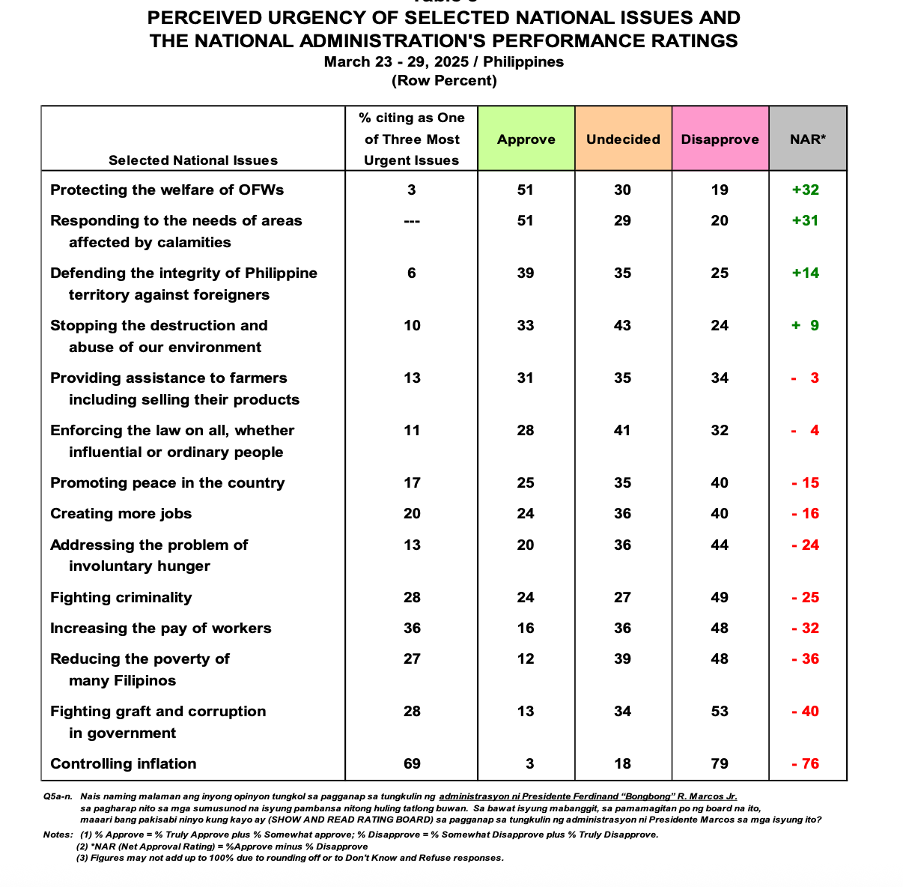
(Pulse Asia Research INC.2025)
Therefore, the rapid expansion of the security cooperation should be understood not only as a response to external strategic pressures but also as a product of favourable domestic political conditions within the Philippines.
4. Domestic Political Conditions in Japan
4-1. Policy Continuity across Administrations
Unlike the Philippines, Japan has maintained a relatively continuous foreign policy direction toward South and East Asia despite several changes in political leadership. Since the second Abe administration, Suga, Kishida, Ishiba, and Takaichi have consistently promoted the Free and Open Indo-Pacific (FOIP) and considered Southeast Asian countries as key strategic partners. Regarding the relationship with the Philippines, negotiations over the RAA began under the Abe administration, resumed under Kishida, concluded under Ishiba, and were further expanded under Takaichi [20]. It suggests that the change of prime minister did not fundamentally alter Japan’s foreign policy direction towards Manila.
4-2. Domestic Political Conditions under the Takaichi Administration
Although Japan’s foreign policy orientation remained unchanged, domestic political conditions under the Takaichi administration helped accelerate security cooperation. Following a decisive Liberal Democratic Party (LDP) electoral victory in the House of Representatives, keeping higher approval ratings (Takaichi is at 68% and Ishiba is at 37%) [21], and waning traditional factional politics in the LDP, which served as an obstacle to smooth decision-making within the cabinet, the Takaichi administration now has huge power and political capacity to pursue more ambitious policies.
Public attitude towards China also reinforced this political environment. Amid deteriorating relations with China, 55% of respondents approved of the prime minister’s stance toward China, while 30% disapproved [22]. The decline in domestic political constraints on the decision-making processes and the domestic backing for the administration’s foreign policy have reduced political resistance to expanding security cooperation with like-minded partners, although Japan-China relations have intensified. Especially, the revision of the Tree Principles on Transfer of Defence Equipment and Technology in 2026 illustrates this point.
Therefore, these developments suggest that Japan’s contribution to accelerating bilateral security partnerships stemmed not from a change in foreign policy direction but from favourable domestic political conditions that enabled the government to implement long-standing policy objectives more rapidly.
5. Conclusion
This article has argued that the domestic environments in the Philippines and Japan contributed to accelerating security cooperation. In the Philippines, the Marcos administration’s return to a pro-alliance foreign policy, together with broad domestic support for a firmer maritime security policy and growing uncertainty surrounding the post-2028 political landscape, created strong current incentives to institutionalise security cooperation. In Japan, although security policy towards the Indo-Pacific remained largely consistent across successive administrations, favourable domestic political conditions under the Takaichi administration enabled the government to implement long-standing policy objectives more rapidly. The finding suggests that these domestic environments have been contributing to policymakers' decisions or reducing costs, thereby building a deeper partnership between Japan and the Philippines.
More broadly, this case demonstrates the importance of incorporating domestic political factors into analyses of international security cooperation. Even when states face similar external threats, policy outcomes may differ depending on leadership, public opinion, and institutional constraints. The recent development of Japan-Philippines security cooperation shows that the timing and form of international security partnerships are shaped not only by changes in the external strategic environment but also by political opportunities within states themselves.
Bibliography
[1]The Nikkei. “フィリピンとの安保協力、異例のスピード 日本「親米政権」逃さず.” [Security Cooperation with the Philippines at an unprecedented speed, Japan does not miss "the pro-US government”]May 29, 2026. https://www.nikkei.com/article/dgxzqoua2750d0x20c26a5000000/.
[2]Embassy of Japan in the Philippines. “Exchange of Diplomatic Notes for Entry into Force of the Japan-Philippines Reciprocal Access Agreement .” Emb-japan.go.jp, 2025. https://www.ph.emb-japan.go.jp/itpr_en/11_000001_01969.html.
[3]The Nikkei. “日本・フィリピン、安保協力「準同盟」級に 南シナ海で中国抑止狙う[Japan and the Philippines upgrade secuiry cooperation to "Quasi-Alliance”, aiming to deter China in the South China Sea].” July 8, 2024. https://www.nikkei.com/article/dgxzqoua04b7c0u4a700c2000000/.
[4]Ministry of Foreign Affairs of Japan. “Signing of the Agreement between the Government of Japan and the Government of the Republic of the Philippines Concerning Reciprocal Provision of Supplies and Services between the Self-Defense Forces of Japan and the Armed Forces of the Philippines,” 2026. https://www.mofa.go.jp/s_sa/sea2/ph/pageite_000001_01456.html.
[5]Ministry of Foreign Affairs of Japan. “Official Security Assistance (OSA).” Ministry of Foreign Affairs of Japan, 2023. https://www.mofa.go.jp/fp/ipc/page4e_001366.html.
[6]NSBT Japan. “Japan’s First OSA Infrastructure Project with the Philippines Highlights Security Ties and an Emerging Defense Market - Asian Military Review.” Asian Military Review, February 17, 2026. https://www.asianmilitaryreview.com/2026/02/japans-first-osa-infrastructure-project-with-the-philippines-highlights-security-ties-and-an-emerging-defense-market-nsbt/.
[7]Ministry of Foreign Affairs of Japan. Review of Signing and Exchanging of Notes for Official Security Assistance (OSA) FY2025 Project to the Republic of the Philippines. Ministry of Foreign Affairs of Japan, 2025. https://www.mofa.go.jp/s_sa/sea2/ph/pageite_000001_01457.html.
[8]Ruth Abbey Gita-Carlos. “PH, Japan Elevate Ties to Comprehensive Strategic Partnership.” Republic of the Philippines, Philippine News Agency, May 28, 2026. https://www.pna.gov.ph/articles/1276085.
[9]Ramirez, Renalyn. “Philippines Confirms 5 Abukama-Class Destroyers Deal with Japan.” Philstar.com, July 8, 2026. https://www.philstar.com/headlines/2026/07/08/2540737/philippines-confirms-5-abukama-class-destroyers-deal-japan.
[10]The Nikkei. “日本、フィリピンに海自護衛艦を速やかに輸出 防衛相会談で合意.” [Japan and the Philippines agreed on the immediate export of JMSDF destroyers at the defense ministers’ meeting] May 31, 2026. https://www.nikkei.com/article/dgxzqoua2882u0y6a520c2000000/.
[11]Santiago Juditho Emmanuel Castillo. Review of Complementary Security: GSOMIA to Bridge the Philippines-Japan Military Intelligence Gap. F.A.C.T.S., 2026. https://www.factsasia.org/blog/complementary-security-gsomia-to-bridge-the-philippines-japan-military-intelligence-gap.
[12]The Nikkei. “日本・フィリピン「機密交換協定」交渉へ 中国念頭に安保情報を共有.” [Japan and the Philippines begin a negotiation on a GSOMIA to share security information amid concerns over China], May 22, 2026. https://www.nikkei.com/article/dgxzqoua223oc0s6a520c2000000/.
[13]The Nikkei. “日本、フィリピンと海洋境界の画定交渉へ 中国・台湾の反発の理由は.” [Japan begins a negotiation on the maritime boundary delimitation with the Philippines. Why are China and Taiwan condemning?]June 4, 2026. https://www.nikkei.com/article/dgxzqoua031y30t00c26a6000000/?n_cid=snstw005&n_tw=1780541835.
[14]Arugay, Aries. Review of CHAPTER 4 Traversing Turbulent Waters: The Philippines” Evolving Indo-Pacific Strategy, 2025. https://www.nids.mod.go.jp/english/publication/joint_research/series22/pdf/Chapter4_AriesAArugay.pdf.
[15]Permanent Court of Arbitration. Review of Cases | PCA-CPA. Pca-cpa.org, 2016. https://pca-cpa.org/ar/cases/7/.
[16]ARIES A. ARUGAY, and MICO A GALANG. Review of The Japan-Philippines Reciprocal Access Agreement: Complementing and Cementing the Hub-and-Spokes System | FULCRUM. FULCRUM, October 9, 2024. https://fulcrum.sg/the-japan-philippines-reciprocal-access-agreement-complementing-and-cementing-the-hub-and-spokes-system/.
[17]Pulse Asia Research INC. “Pulse Asia Research’s March 2025 Ulat Ng Bayan Survey: Key Findings,” April 2025. https://pulseasia.ph/wp-content/uploads/2025/04/UB2025-1-MR-on-Performance-and-Trust-Ratings-of-Top-Officials-Final.pdf.
[18]Shankar, Priyanka. “Philippine Vice President Duterte’s Impeachment Trial Begins: What We Know.” Al Jazeera, July 6, 2026. https://www.aljazeera.com/news/2026/7/6/philippine-vice-president-dutertes-impeachment-trial-begins-what-we-know.
[19]Ramirez, Renalyn. “66% Of Filipinos Favor Marcos’ ‘Assertive Response’ to WPS Dispute — OCTA.” Philstar.com, July 10, 2026. https://www.philstar.com/headlines/2026/07/10/2541227/66-filipinos-favor-marcos-assertive-response-wps-dispute-octa.
[20]Ministry of Foreign Affairs of Japan. Review of Prime Minister KISHIDA Fumio’s Visit to the Philippines (November 3). Ministry of Foreign Affairs of Japan, 2023. https://www.mofa.go.jp/s_sa/sea2/ph/page1e_000794.html.
[21]The Nikkei. Review of 支持率を追う 日経世論調査アーカイブ. 〜ビジュアルデータ, [Tracking a review of approval ratings; Nikkei public opinion poll archive, visual data.] March 27, 2017. https://vdata.nikkei.com/newsgraphics/cabinet-approval-rating/.
[22]Asahi Shinbun Digital. “高市内閣支持68%高水準続く 対中姿勢「評価」55% 朝日世論,” [Takaichi Cabinet approval rate remains high at 68%; 55% approve its stance toward China; Asahi Poll.]December 21, 2025. https://www.asahi.com/articles/ASTDP2Q0CTDPUZPS002M.html.